What’s Really Happening in the UK Property Market?
If you’ve been keeping an eye on the headlines, you might be wondering: what’s actually going on in the UK property market right now?
The truth is, the national picture only tells part of the story. When you dig a little deeper, a far more interesting, and complex, landscape begins to emerge.
A Market Moving… But Not Uniformly
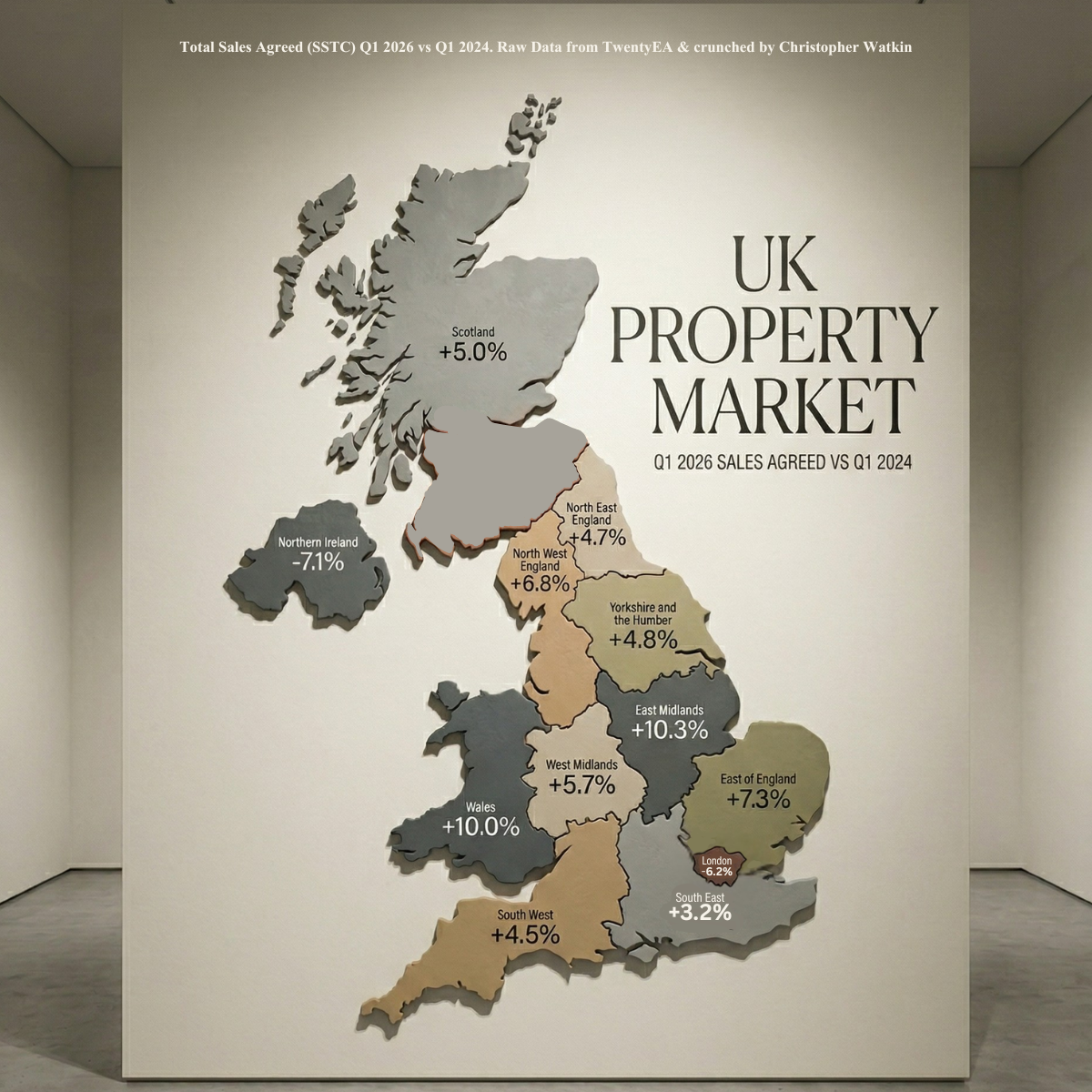
Looking at the data from Q1 2026 compared to Q1 2024, the number of homes sold subject to contract has increased across most of the UK. On the surface, that suggests a market regaining momentum.
Here’s how the regions stack up, from strongest to weakest:
East Midlands: +10.3%
Wales: +10.0%
East of England: +7.3%
North West: +6.8%
West Midlands: +5.7%
Scotland: +5.0%
Yorkshire & The Humber: +4.8%
North East: +4.7%
South West: +4.5%
South East: +3.2%
London: -6.2%
Northern Ireland: -7.1%
At first glance, this paints a positive picture. Most regions are seeing growth in agreed sales, with particularly strong performance in the East Midlands and Wales, both achieving double-digit increases.
Steady Growth, Not a Boom
Across much of the Midlands, the North, and Scotland, we’re seeing something quite interesting:
This isn’t a booming market, but it’s not struggling either.
Instead, it’s steady, sustainable, and far more balanced than in previous years.
What does that mean in real terms?
Buyers are still active, but more price-sensitive
Sellers need to be realistic to achieve a sale
Well-presented, correctly priced homes are moving, and often quickly
Overpriced properties are sitting and stagnating
In short, it’s a “working market”: one driven by genuine need rather than speculation.
London: The Outlier
Then there’s London, which continues to tell a different story.
Overall, activity is down -6.2%, but that headline hides an important distinction:
Inner London: -9.3%
Outer London: -1.5%
This gap highlights a shift in buyer behaviour. Affordability pressures, lifestyle changes, and evolving priorities (like space and hybrid working) are reshaping demand.
Buyers aren’t disappearing, they’re just becoming more selective about where and what they buy.
The Rise of Micro-Markets
Here’s where it gets really interesting.
Even these regional figures don’t tell the full story.
When you zoom in further: into counties, towns, and even individual streets, the market becomes far more fragmented.
Within the same town, you might find:
One area where homes are selling quickly with strong demand
Another where properties are taking longer and seeing price reductions
It becomes a patchwork of micro-markets, each behaving differently.
Or to put it simply:
There is no single UK property market: there are thousands of them.
So What About Sawbridgeworth & Bishop’s Stortford?
This brings us closer to home.
What’s happening locally in Sawbridgeworth and Bishop’s Stortford may look very different from the national averages, and even from each other.
Compared to a few years ago, we’re seeing:
Buyers who are more informed and cautious
Pricing strategy becoming more critical than ever
Demand still present, but far more selective
Certain types of homes outperforming others significantly
Some properties are still generating strong interest and multiple viewings… while others are struggling to gain traction.
The Big Question
So, with all of this in mind:
What do you think is happening to property values and demand in Sawbridgeworth and Bishop’s Stortford right now?
And more importantly…
How does it compare to what you were seeing a few years ago?
If you’re curious about how your specific home, or your street, fits into this evolving market, it’s worth having that conversation.
Because in today’s market, hyper-local knowledge isn’t just helpful… it’s everything.